

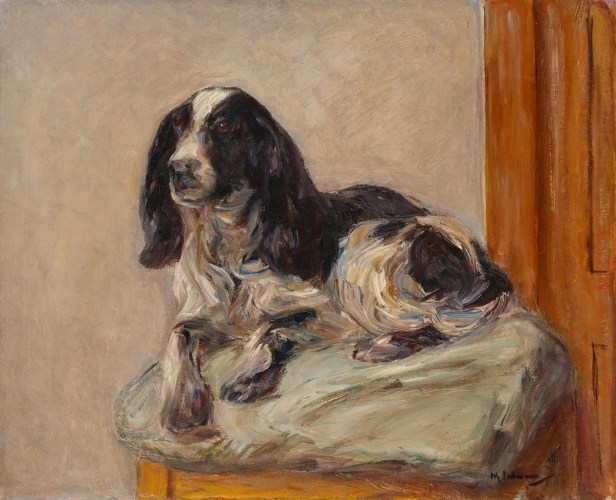
Op invaluable.com wordt dit schilderij aangeboden van Max Liebermann. Er zit een Noordwijks tintje aan want het afgebeelde hondje, een Spaniel, was een Nóórdwijks hondje. Ik verwijs naar een eerder blog. Lees vervolgens deze tekst op invaluable.com:
From the late 19th century, the German impressionist Max Liebermann spent his summer months painting in the Netherlands. In Amsterdam, Laren and Noordwijk, he primarily devoted his attention to motifs from the world of work. The artist, who came from an extremely wealthy family himself, was interested in depicting different professions and occupations. He created images of washerwomen bleaching, weavers, market vendors, grooms assisting riders at the beach or hunters in the dunes. He also turned his attention to working animals: in pictures like this one, they find their way into the artist’s oeuvre as individual creatures attributed membership in a group, such as the hounds Liebermann depicted in a series of paintings (cf. Werkverzeichnis Eberle nos. 1913/25-1913/30). Unaccompanied by any people, the spaniel in our work is assigned a prominent role in which the dog is portrayed reclining grandly – a type of picture normally reserved for human beings. Animal portraits have always been seen as a distinction for exceptional achievements or success in breeding and embody the pride of their owner. But, in addition to characterising his anatomical virtues, Liebermann has also sought to bring out the characteristic traits of his model in this painting, as he would in the case of a human portrait. The painter, who owned a dachshund himself, the legendary Männe, presents the spaniel to us in a relaxed and nonetheless erect pose, with the soft, swirling fur of its coat in an interesting colour – passionate during the hunt, friendly and loyal towards his master. This wonderful portrait of a dog is further dignified by its provenance. It comes from the collection of the important German philosopher Eva Cassirer, whose father Alfred Cassirer was an important collector of German and French impressionists, among other artists. He shared this passion with his brother, the Berlin art dealer Paul Cassirer. Paul Cassirer also owned a holiday home in Noordwijk and that year, together with Max Liebermann, they accompanied a hunter in the dunes and looked at his dogs in their kennel. Most of the portraits of dogs created as a result of this visit are considered to be lost. The large scene “Jäger in den Dünen” (Eberle 1913/34) was already purchased from Paul Cassirer by Vienna’s Kunsthistorisches Museum in 1914 and is now to be found in the Österreichische Galerie Belvedere.
 BLOGnoordwijk (Heimatsammlung)